Convert ZIP to TAR.
Convert a ZIP to a TAR archive for Unix and CI workflows. Directory structure and contents preserved exactly.
Inside The Conversion
See The Input. Inspect The Result.
A real ZIP to TAR conversion using a sample file. Compare the files below, then use the converter above with your own file.
Recorded Sample
Converted on the server in this run.
harbour-lane-bakery-files.zip
Archive Contents
harbour-lane-bakery/
 13.1 KB  harbour-lane-bakery-logo.png
   621 B  harbour-lane-bakery-logo.svg
   229 B  harbour-lane-price-list.csv
108.5 KB  harbour-lane-price-list.pdf
harbour-lane-bakery-files.tar
Archive Contents
harbour-lane-bakery/
 13.1 KB  harbour-lane-bakery-logo.png
   621 B  harbour-lane-bakery-logo.svg
   229 B  harbour-lane-price-list.csv
108.5 KB  harbour-lane-price-list.pdf
Previews show the sample files from this recorded conversion. Choose Input or Result to focus on one file.
View The Original Run Capture
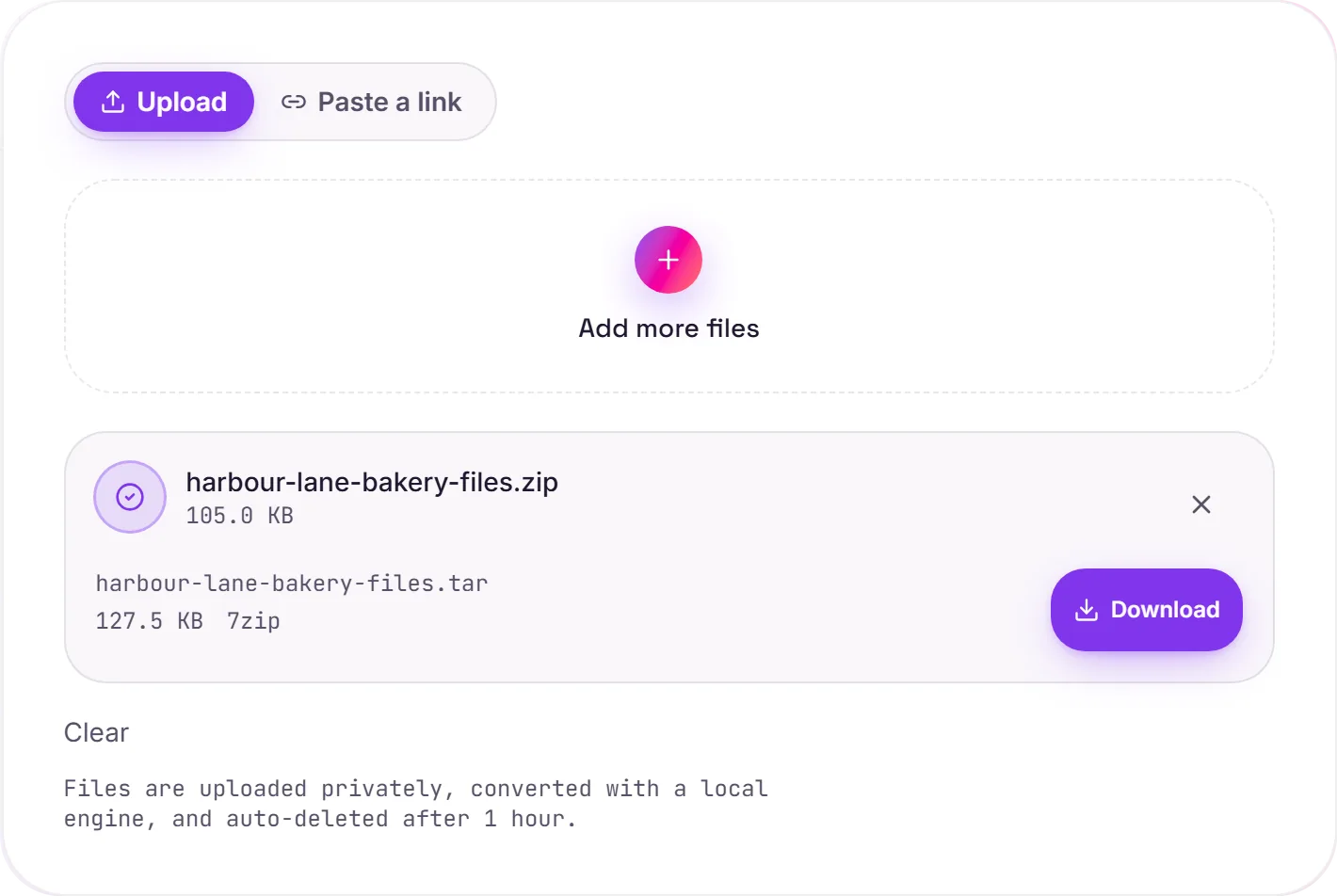
A screenshot of the completed run, preserved in its original theme. The comparison above adapts to your current theme.
ZIP to TAR for Unix workflows
TAR, short for "tape archive", is the standard way to bundle files on Linux and Unix, and it shows up everywhere in CI pipelines, Docker builds and server tooling. Converting a ZIP to TAR gives you a single archive those tools expect, with the directory structure and contents carried across exactly.
A plain TAR doesn't compress
This is the one thing that surprises people: TAR only concatenates files. It doesn't compress them. A ZIP is already compressed, so a plain .tar of the same contents will actually be larger. That's expected. When you want a compressed Unix archive, reach for .tar.gz (tgz) or .tar.bz2 (tbz) instead.
Nothing is altered
Contents are extracted and repacked unchanged, every file comes out byte-for-byte identical, just in a TAR container. Going back to Windows-friendly ZIP? Use TAR to ZIP.
How it works
- 01
Upload your ZIP
Drop a file or pick one from your device. Private by default.
- 02
Repack with 7-Zip
ZIP is extracted and repacked as TAR using 7-Zip, every byte preserved, no paid API in the loop.
- 03
Download
Grab your TAR.
Bit-for-bit faithful, files never altered
Folder structure preserved
Private uploads, auto-deleted after 1 hour
No watermark, no signup to try
Free and open-source engine (7-Zip)
ZIP to TAR
Your archive is unpacked and repackaged as TAR, keeping the folder structure and file names. The contained files are not altered, only the container format and its compression change.
Common questions
Is it free?+
Yes. Convert ZIP to TAR free. No signup and no watermark. Free covers 10 server conversions a day, up to 100 MB a file. Pro removes the daily limit and raises the file limit to 2 GB.
Is my archive private?+
Uploads go to a private bucket, are converted, and auto-delete after 1 hour. Files never touch a third-party converter.
Are my files changed?+
No. Contents are extracted and repacked unchanged. Every file comes out byte-for-byte identical.
Related conversions